

THE SNAPSHOT
Led by Ģ¹½AV, BioLabs East will establish a new Good Manufacturing Practice (GMP) facility in Nova Scotia, giving academic, health care, and industry partners the specialized infrastructure needed to accelerate research toward clinical trials. The facility will produce small batches of vaccines and cell therapies to the exacting standards required for Health Canada-authorized trials. It is part of a national effort to strengthen domestic biomanufacturing, support local sector development, and improve access to lifesaving innovations for Canadians.
THE CHALLENGE: A chasm rarely crossed
 Ģ¹½AV’s associate dean of research in the , (shown left), describes the gap between research pursued at the university and its real-world application as a chasm rarely crossed. Too often, promising ideas stall at the edge, confined to academic journals rather than advancing into clinical trials and practice.
That gap is especially frustrating, she says, because Nova Scotia is home to one of Canada’s premier vaccine-testing facilities — (CCfV). A collaboration of Ģ¹½AV, IWK Health, and Nova Scotia Health, the CCfV is on the other side of the gap, where vaccines undergo the final hurdle: human studies to prove their effectiveness.
Ģ¹½AV researchers excel at the basic and pre-clinical work that produces initial formulations for vaccines or drugs. But to meet Health Canada standards and move to human trials, a scientist must know it is safe for delivery to humans.
Currently, promising discoveries from Ģ¹½AV must be handed off to facilities with the necessary manufacturing capacity, often outside the country. With that handoff comes a loss of control, not only of the science as it progresses but also of the intellectual property, despite being funded by Canadian taxpayers.
“We need to be able to say, out of all the possible discoveries we could work on, this is the one that we need to develop here to a standard that we know is effective, has potential to be safely used in humans, so that we can pursue the science and protect the IP,” says Dr. Denovan-Wright.
The COVID-19 pandemic underscored why Canada needs more homegrown capacity, says the researcher. While Ģ¹½AV and many other Canadian and international labs made essential contributions to the science behind the vaccines, it was the United States that claimed most of the credit — and the profit.
“A lot of the research that had been going on for 30-plus years around the world led to the COVID vaccines. Millions of hours of work on the basic science, but we couldn't take it to the next step — the U.S. could,” she says.
THE SOLUTION: Building the bridge
Ģ¹½AV’s answer is BioLabs East, a facility meant to close the gap that keeps Canadian discoveries from becoming Canadian cures.
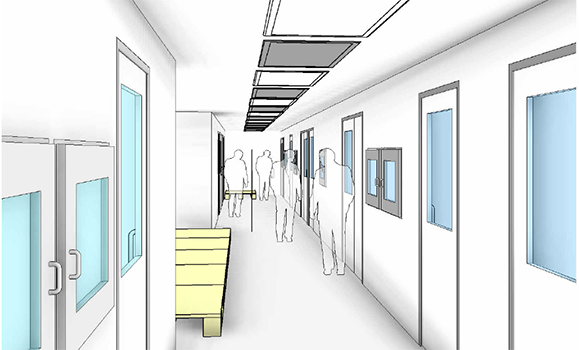
The Good Manufacturing Practice (GMP) facility moniker dramatically undersells reality. While sounding relatively innocuous, this official term necessitates the peak of precision — rooms where air is filtered and refiltered, where machines are sterilized, then sterilized again, where workers pass through airlocks and cocoon themselves in gowns, masks, gloves, and boot covers, and where every deviation is logged and investigated to understand the root cause.
This is what Health Canada demands for anything destined for human use. The exacting nature of the construction is a substantial undertaking and would likely not be happening if a sequence of fortuitous events and partnerships hadn’t come together.
The first was Ottawa’s $2-billion fund to support its Biomanufacturing and Life Sciences Strategy. Announced in 2021 in the aftermath of COVID, the massive new investment was launched to strengthen domestic capabilities, build a talent pipeline, and improve pandemic preparedness.
 Dal was ready with a funding application, having already devised a plan for a GMP facility that answered each of these goals. And researchers at Dal, led by (shown left), director of CCfV and professor of pediatrics, microbiology and immunology, had already established the necessary national partnerships.
Ģ¹½AV secured $12.9 million as part of the $143-million Canada Foundation for Innovation’s Biosciences Research Infrastructure Fund secured by the University of Ottawa and McMaster University. The Government of Nova Scotia’s made further $8-million investment to move the project forward.
The value of the project was so compelling it attracted an additional $4.45M of private donor support, allowing Ģ¹½AV to meet its obligation to fully match the Federal grant.
But at the time of the initial grant application there was one critical aspect of the GMP project that remained a bit tenuous: where to put it.
“We were just about to hit send on the proposal,” says Dr. Denovan-Wright, acknowledging that they were “sweating” over the solution they had proposed for the space.
Then came fortuitous event number two. A Nova Scotia-based biotech company announced it was vacating its holdings in the province, leaving behind sophisticated equipment and a leasable property primed to be elevated to GMP grade.
“Everything was there, all the support labs that we would need for a GMP facility,” she says. "It was like it was sent from heaven.”
The new 15,000-square-foot facility in Dartmouth, N.S. will eventually support 20 professional research staff, with 6,000 square feet dedicated to GMP clean rooms and another 6,000 of preclinical space. The renovation is expected to be complete before the end of 2027.
THE WORK: The art of the possible
The next important piece of the GMP puzzle came in the form of collaboration. In Nova Scotia, Ģ¹½AV is working closely with , , and the Canadian Center for Vaccinology to ensure that BioLabs East is seamlessly integrated in the province’s health infrastructure.
“When you cluster people and organizations together, you get the art of the possible, of people thinking differently,” says Dr. Denovan-Wright. “The university can't do it all. The hospitals can't do it all. Small and big businesses can't do it all. We have to work together.”
Doris Grant, the chief executive officer of Life Sciences Nova Scotia and managing director of the says the new facility marks another critical addition to the province’s expanding life sciences ecosystem — a network of organizations, laboratories and companies that is rapidly gaining momentum.
“BioLabs East is exactly the kind of catalyst our ecosystem needs,” she says, “world-class infrastructure and talent that attract industry partners to Nova Scotia, advance vaccine and cell-therapy production, and expand opportunities for clinical trials. It’s a pivotal step in strengthening Canada’s biomanufacturing capacity.”
Just as BioLabs East is bringing together partners in Nova Scotia, it also connects the province to the national ecosystem of hubs in the Canadian Biomanufacturing Cooperative. The coordinated network also includes the Universities of Ottawa, Alberta, Saskatchewan and McMaster, each with complementary strengths integrated to ensure Canada is ready for the next pandemic.
“Dal is part of an effort to improve our national capabilities,” says CCfV director Dr. Halperin, who is co-leading the GMP project with Dr. Denovan-Wright. “Not every step along the way needs to be done at Dal. We’re fine with things coming and going in both directions, because that efficiency and that coordination is really what is necessary to address future pandemics.”
Beyond vaccines, Dr. Ashley Hilchie, senior director of research at Nova Scotia Health, is helping guide a new generation of cell therapies into BioLabs East. These living medicines are treatments built from human cells that can be reprogrammed to fight disease. Nova Scotia Health will lead clinical trials to test new cell therapies manufactured at the facility for cancer and autoimmune diseases.
A key example is CAR-T therapy which is part of clinical care for several Nova Scotians living with cancer. The treatment requires the patient’s blood cells to be collected and shipped to an American vendor where the cells are reprogrammed, frozen, and then shipped back to Nova Scotia where they are reinfused into the patient. The process can take weeks, involves significant costs, and is vulnerable to delays at the border.
The same obstacles hinder Nova Scotian researchers developing cell therapies in their quest to take discoveries from bench to bedside. BioLabs East will enable the entire clinical pipeline for CAR-T and other cell therapies to take place in the province. To put the project in motion, the is providing $2.1 million in new equipment.
“Biolabs East marks an important milestone in our journey toward making advanced cell therapies available to all Nova Scotian’s who need them,” says Dr. Hilchie. “By producing GMP-grade products for clinical trials, and by establishing national partnerships, we are bridging the gap between discovery and delivery. And by building clinical trial capacity, we can bring the most innovative medicines available to Nova Scotians”.
THE IMPACT: Investing in health sovereignty
 Medical breakthroughs aren’t the only goal for BioLabs East. The facility is also designed to fuel Nova Scotia’s growing life sciences industry, by opening its doors to private-sector partners. Partnering with biotech and pharma companies on early-stage research and producing GMP-grade products for clinical trials, will allow the facility will be a critical piece of the puzzle helping the province reach its target of building a billion-dollar sector by 2032.
Dr. Bryan Tennant, scientific director at , says BioLabs East will complement the company’s work, adding that the facility’s ability to manufacture safe vaccine and drug therapies for phase one clinical trials with the CCfV and Nova Scotia Health could significantly accelerate their development.
"Ģ¹½AV's vision for a small-scale GMP facility represents an exciting opportunity to strengthen the local ecosystem for innovative research and development,” he says. “At GSK, we are focused on delivering breakthroughs in vaccines, immunology, respiratory, and oncology, and this facility could play a pivotal role in supporting early-stage clinical development.”
Beyond the bricks and mortar, Dr. Tennant notes the talent produced will be invaluable, saying “this facility has the potential to cultivate a robust pipeline of skilled professionals. For us, it’s not just about infrastructure — it’s about building partnerships and investing in the future of scientific innovation right here in Canada."