

Teaching the Mi’kmaw language holds two very special purposes for Curtis Michael: to retain his language and to ensure it continues to be learned and spoken by others.
Michael, a resident of the Sipekne’kati First Nation (Shubenacadie) since childhood, says his maternal grandparents were among the few families in the area that could speak L’nui’suti — the Mi’kmaw language — and they did so with him and his cousins, balancing out the English they spoke in day school off reserve.
When Michael was just 10 years old, his grandfather passed away.
“That hit me hard — still does,� he says. “My wish is, when I go into Wa’so’q — the light [afterlife] — I want to speak Mi’kmaw to him. That’s my drive. I just want to speak to him in our language because he spoke it to me when I was a little boy.�
Michael’s paternal side of his family lives in Eskasoni, Cape Breton. When he would go there, he’d visit his grandmother, whom they all called Dr. Granny.Ìý
Explore Indigenous Studies at Dal
Learning from indigenous scholars, you'll benefit from the perspectives and insights of instructors who have both lived and studied the topics under discussion. Learn more.
Known as “an icon of the language and the culture,� Michael would ask her questions about Mi’kmaw words, tenses and meanings — and with those explanations, he’d learn more about his culture, people, beliefs, histories and more.
“So that’s what I do when I’m teaching,� says Michael. “It shows people, ‘Hey, here’s my culture. Here’s how we believe.’�
Keeping learning fun
Michael taught the Mi’kmaw language to children in his community for years, so when he started as an instructor at Dal in 2021, he brought a lot of teaching practices he’d developed earlier with him. That meant keeping things fun and engaging.
He says his students enjoy the mechanics of learning the language and the relationship between the language, nature and tribal wisdom. He describes the makeup of his classes “like a collage,� with both domestic and international students and some being of Mi’kmaw heritage.
Several Dal staff and faculty members have taken his courses, including Dr. Margaret Robinson, Indigenous Studies program coordinator in the Faculty of Arts and Social Sciences (FASS).
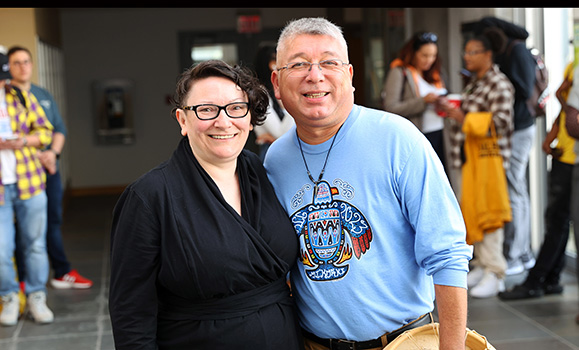
Margaret Robinson, left, and Curtis Michael.
Dr. Robinson saw first-hand how language loss affected her own family’s connection to culture, noting her grandmother had lost her language because of day schools.
“Studying with Curtis was a way for me to connect with the worldview and values embedded in our language,� she says.
Studying with Curtis was a way for me to connect with the worldview and values embedded in our language.
She said it was also “the most fun� she has had as a learner. He brings the language to life using motions and expressions, making learning easier and more memorable, she says, adding that he learned all his students’ names.
“His levity and positive feedback lowered my stress and made it easier to learn.�
Preserving language and culture
Curtis teaches both of the Mi’kmaw Language for Non-Speakers courses (INDG 2901 and 2902), offered in FASS. These courses are accepted towards the language requirement for Bachelor of Arts students and can be taken towards a minor in Indigenous Studies. They are part of the manyÌýlanguage course offeringsÌýopen to both degree and non-degree students. The courses are open to students from Saint Mary’s University, Nova Scotia College of Art and Design, and Mount Saint Vincent University as well.
Ìý“Whether you have Mi’kmaw roots to nourish,Ìýor you want to support Indigenous language revitalization, these courses are the place to start,â€� says Dr. Robinson. “Curtis brings L'nui'simkÌýalive, showing it’sÌýa vibrant, living language.â€�Ìý
Michael was appointed a full-time assistant professor in FASS in 2025. FASS Dean Dr. Jennifer Andrews notes how special Michael’s courses are.
“I am incredibly proud and pleased to have Curtis Michael teach the Mi’kmaw language classes,� she says. “His lifelong passion for the language is something he shares everyday with his students and community.�
Michael says to him, teaching “doesn’t feel like a job.�
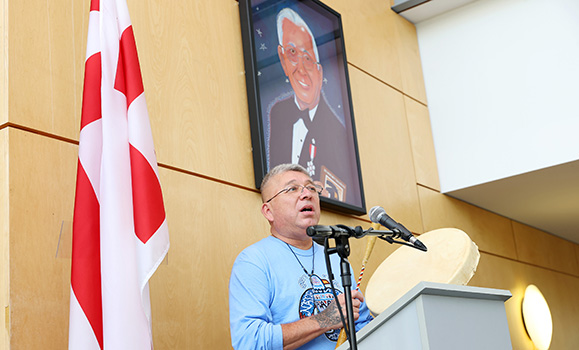
Curtis Michael performs at Daniel Paul portrait hanging event in fall 2023.
He says sharing his joy of learning and teaching L’nui’suti holds an important place in his life as it helps ensure the language will continue to be spoken and taught and so, too, will the stories and cultures that go along with it.